
raw material of carpets- cotton
The raw material of handmade carpet – cotton
The origin of cotton and its usage
One of the most important cellulose fibers is cotton which economically called white gold. The word cotton is a Pahlavi word.
Archaeological research shows that cotton was cultivated in India for about three thousand years ago.
The cotton plant is the source of raw materials for the textile industry and dependent industries. The Major consumption of cotton is in Spinning and weaving mills for the production of yarn, fabric, carpet, kilim, Zylou and various types of carpets. Cotton is used as the warp and weft in the handmade carpet industry and is a relatively inexpensive filament.
Factors Affecting Cotton Quality
Cotton is grown in most parts of Iran, especially in Gorgan, Turkmen, Isfahan, Yazd.
Cotton fibers are in white, yellow, brown and gray, and vary in length and diameter.
The longer the cotton filaments are, the better it is. The strength of cotton fibers depends on the color of the fabric, its elegance, its softness, its transparency, its degree of purity, and the moisture content of the fiber. Whatever the white cotton is, its purity is higher. Conditions such as the suitability of the earth And atmospheric conditions (high humidity and sunlight) affect the quality of cotton.
structure of Cotton plant
Cotton is grown better in areas where the temperature difference between the day and night is low, and cotton can be grown when the temperature is at least 14 ° C. Cotton can be cultivated when the temperature conditions reach this level in the spring. the Cotton fruit is in capsule form in the form of a walnut and is called a boll. Each ovum contains 3 to 5 egg cells, the cotton fibers begin to grow on the ovum in a crusty and dense mass. An ovum containing fiber. production of Cotton requires 50 to 80 days.
Cotton harvesting practices
Cotton harvesting is done manually and mechanically. When several bolls reach and open on most cotton plants in a field, harvesting begins. Cotton picking is done in a succession of steps.
Hand-picking cotton is very difficult and time-consuming, and in the past carpet made from cotton yarn was a special and expensive carpet, but since the 19th century, due to the prevalence of cotton spinning, It is very popular in carpet weaving. the quality of cotton that is handcrafted is very good, but today they use machine harvesting because of their time-consuming and hard work.
cotton storage conditions in stock
After harvesting and cleaning the cotton, it will be stored for a short time, which will affect the quality of cotton. In the warehouse, the temperature and humidity should be kept to the minimum and the shelf life should not be prolonged.
The process of cotton cleaning from entering the factory to baling is as follows:
1.Classification in terms of quality
2.Drying in the drying machine and preliminary cleaning
3.Cleaning and gliding in cleaning machines
4.Opening and disassembling external materials such as sand, wood chips, etc. by car
5.Sewing cotton yarn in a jin machine
6.Stapler: The compression of cotton fibers is called baling, which prevents the cotton fibers from being damaged during transport.
Cotton in handmade carpet
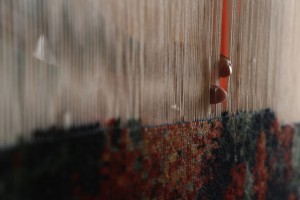
Cotton thread because of its non-deformation and resistance properties is suitable as warp in handmade carpets.on the one hand, Cotton fabrics create a more robust structure and, on the other hand, can create a regular texture. Because the final weights can be better tolerated without drooping or restraint, which is a score of cotton yarn compared to wool yarns. But the cotton yarn is rarely used as a yarn for weaving, because of the natural haze of cotton And that there is less elastic cotton than wool, and on the other hand to dye the cotton you should do the various processes, Unlike cotton wool dyeing. generally, Cotton dyeing is very difficult in the traditional way.
Farahan carpet, which is always looking for superior quality, uses cotton yarn to produce warp and wefts, which is one of the reasons for Farahan carpet differentiation.
retrieved from the science of fibers (author: Setare Amiri)


