
Why vegetable dying?
Types of Dyes
The fibers used as yarn in handmade rugs, whether silk or wool, should be dyed to produce colored fibers that will resurface to the woven carpet surface. Among all the artistic techniques used for carpet weaving, the dying wool can be considered very important.
Dyeing of carpet fibers is done using two groups of dyes: synthetic or chemical dye and natural dye.
Artificial colors
Chemical dyes were initially used only in the form of expensive natural colors that were not available to them, such as Nile and Quartet, then spread across all color spectra. These colors were discovered in Europe in the late eighteenth century and became very popular in the nineteenth century.
These dye-based ingredients were based on acidity and were quickly stabilized on wool and silk, and are known as aniline dyes. Aniline dyes quickly expanded and were exported to high levels in the east, but after a while, they were banned by Naser-al-Din Shah because of their very low light-insistence and very severe coughing.
After a while, in Germany, nitric paints were found to be more durable and easier to use than aniline dye, and are still being used successfully.
With the discovery of artificial Neil, a new era of chemical paints began. These colors were soluble in alcohols, they proved to be on the animal and vegetable fiber, and they also have a lot of stability, and the use of these colors is extremely popular.
natural colors
Natural colors include plant, animal and mineral paints, most of which belong to plants, which are dried, Powdered, then used as a colorant after soaking or oxidation.
Advantages of using natural dyes in handmade carpets
_ Intrinsic Gravity of Natural Dyes
_Armation caused by the use of natural dyes
_ Create special events
_ Not having environmental problems
_ Avoiding the dangers of using artificial dyes
_ Creates additional qualities such as antimicrobial, antidiabetic, odorant, and durability
_ Compatibility with human skin
_ Simple application
_ Not repeatable for specific goods
_ Concerned about the end of resource supplies for the production of synthetic dyes
_ High value added
_ Ability to identify the identity of the carpet due to the production of special dyes in specific places
_ Change due to different conditions
_ Absorb and eliminate some environmental gases
mordants
When substances do not resemble dye molecules and fiber molecules, substances such as stabilizers or mordants are used. The mordants are metal salts that have a reciprocal desire for fibers and colors, which improve the color stability and also affect the color spectrum and the intensity of the colors.
.The mordants are divided into two general groups: vegetable and mineral categories.
Herbal mordants
These mordants are completely colored and not only used as mordants but also used as dye material. There is a series of tannin-colored plants that are found on the skin and the fruits themselves and a lot of plants, especially oak bark.
Traditional dye workers have known the Mazaji plants Due to the experience over time, plants such as dwarf (skin), helix (whole plant), oak (pair), pistachios (skin), pomegranate (skin).
Mineral mordants
Mineral mordants are referred to as all water-soluble metal compounds, most of which are the intermediate elements of the periodic table. These metals can make a solid bond between them, the color and the lips. These mordants include a white alum, a copper sulfate denture, a chlorinated tooth, and so on.
The most important mordant used in carpet dyeing is double salts of aluminum and potassium called a white alum
mordant is done in three different ways
_ mordanting before dying
_ mordanting and dying simultaneously. The best and most practical method is to do this
_ mordanting after dying
Natural dyes and their attributes
madder
Herbaceous vegetable rhizosphere, height is about half up to one and a half meters. The part of this plant used in dyeing is underground members, the rhizome and the root, with a finger thickness and a length of one meter. madder has a reddish-brown color and is easily separated from its lower, bright red or yellowish-reddish.at first, its flavor is mild but after a while, it is scratched.
History of madder plant
The red color from madder is red in the past and is still in use. The painted garment was found in Greek graveyards 6,000 years ago. The madder species of Tincterrom and Ruby Virgin has the highest amount of color from one to two percent.
When the plant is 2 years old, it is collected and exposed to the sunburn to dry, then crumble and powdered.
madder has a diverse amount of dyestuffs, most of which have an anthraquinone base, and about 20 types have been identified, with at least 11 of them dying.
The planting site of this plant is located in western Iran such as Arak, Damavand, Tabriz, Yazd, Khoy and so on.
In the past, the dough was used for dyeing madder, about one-third of the amount of water used from the dough and the orange-colored shades are obtained. To change color shades to reddish dyed wool, they were placed in river water for 10 to 24 hours.
With madder, you can get colors like cream, red, mud, orange and light brown to garlic with different mordants.
For dyeing, you can use madder as a powdered directly in the dye bath or extract the madder powder and then use it.
With the help of a white alum, it can get bright red to dark colors
Red Beetle
Red beetle is the best animal dye material that alone or in combination with vegetable dyes makes it possible to obtain a variety of shades of color, especially for carpet, and since human history has been used with this insect, its use is red. And the red word itself has been taken from this insect. Some believe that Iranians have used this dye for over two thousand years.
This material is originally an insect of the same name that is commonly used in large groups. The most famous is Nepal’s red-colored beef in a region called Kasil in Mexico, which was taken to Europe in the early nineteenth century before the Spaniards spawned it in Mexico before the nineteenth century.
Its appearance is almost like a chickpea that is mistakenly called the dose of dill, which is the food of this sap of the plants that live on them. But after sucking the sap, it secretes a gum, which causes the death of the insect. This insect binds firmly to the plant’s body and, in order to protect itself from contact with air, provides a solid shell that is naturally rich in colored beads. The shells are dried and powdered
The breeding of this insect in the past was common in southern Iran, especially Balochistan has been a good place for this insect.
The main color of the insect is the carmine acid, which is a unique colorant in terms of color and stability and produces a glossy red color that can be rolled out in the presence of iron oxide to the purple. The insect is divided into several groups based on the location of the growth, including the Indian Indigenous, Polygonal, Quercus, Mexican, and others. The use of a special red Mexican color is common in the carpets of Kerman and Mashhad.
For dyeing, it is necessary to use different mordants to create the necessary stability and different spectra. For red dyeing, most of the abrasions of white alum, tin chlorine, potassium bichromate are used.
mignonette
A two-year-old, non-cracked herb has a straight, angled and up to half-meter height, stem originate from the southern French regions.
mignonette has two species, domestic and wild. The domestic shrubs used for color dyeing have a bright green color, with narrow and long branches and a length of one to one and a half. Its wild bush has a lot of foliage and less fruit. All parts of mignonette have a dye, but less in the root
In the last months of spring and early summer, spray the sperm on the ground and after the growth, it needs to be dried and placed in the sunshine. After drying the parts that are in the soil, due to the low amount of dye matter is removed and The rest are crushed
mignonette is used not only for dyeing yellow but for lemon, orange, olive, green or other colors. The colors obtained from mignonette give a special softness to woolen yarns. The best method of spray dyeing is mordanting and then dying.
Walnut
walnut is the Pahlavi word and its first birthplace is Iran, India, and Turkey.
A beautiful tree is a base, with leaves of individual and large leaflets. Walnut shells do not need to use metal mordants to increase stability due to the presence of tannins, but different mordants can be used to create a variety of colors for specific uses, which, of course, will produce a slight color change. Whether the leaves and fruits are used for dyeing the fibers yellow, light brown, yellowish, gray and brown fibers.
The mordants that are most commonly used in walnut shells are iron sulfate, bichromate, and white alum
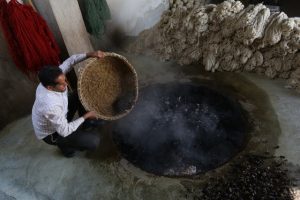
the Nile
The only natural substance in the production of blue shrimp from the plant is the Nile. The main ingredient is the Indigo blue color that produces bright blue to garlic blue
Nail color is one of the most important natural colors despite its hardness
The herbaceous Nile is a bush-shaped plant, two years old with a wooden stem and cluster of flowers, white, pink and purple, cultivated in the early spring and found in the south of Balochistan and the country. The history of the plant is Indian.
The method of work is that after separating the leaves from the branches, they pour them into wooden basins, placing the heavy wood on the leaves and filling the dock with water. After several hours, the fermentation of the leaves begins, and carbonic anhydride and oxygen are released from the leaves. The surface of the pond’s water first turns yellow and then green. After completing the fermentation, the leaves are eaten from the water and shed in a different container and quickly cooled. The presence of oxygen in the air causes it to oxidize and its blue color is highlighted. However, adding some ammonia accelerates the deposition process. After completion of the sedimentation, the water is distilled off and the precipitate is removed from the filter. The result of the operation is large pieces, and sometimes even soft powder.
The main feature of Nile is that if it keeps its leaves in front of the sun’s rays, it will be white and if you rub the same leaf with your hands, the green matter comes out that quickly oxidizes in the vicinity of the air and turns blue.
Due to the price of Nile, smuggling and the addition of artificial materials is very common. But it has features that help you easily recognize this plant.
From the heating of the nail on the gas light pump, the color of the red light turns out that if you take the glass on top of the dish, it crystallizes into glossy needles that are called indigotin.
The Nile has a special smell
_ If you burn a piece of Nile, it will be smelled for a special nail.
indigo
indigo is the name of a plant that is called in Arabic, and some of it is called Mazandaran. It is called Shalam Hassani or Hanay-e-Jackal, known as Kermani.
It is a plant that is two years old and has a height of 90 to 100 cm, and leaves are arched and grouped. The flowers of this yellow plant and the fruit of the mango are short-colored coriander, with a root of a vertical and a bit thick. From the leaves of this substance, blue colored garlic called Sesma is taken.
The plant is native to China. In Iran, Kermanshah and Taq Bostan are abundantly seen, and another type is found in northern Iran and along the banks of the river.
Planting its seeds in the spring is in the range of 20 to 30 cm. Their growth is slow in July but then grows fast. The leaves are picked four to five times a year when they are thick, shiny and oily.
Pomegranate
Pomegranate is a beautiful pineapple with a height of 2 to 5 meters, young leaves and a few days old and full of green leaves, and beautifully colored leaves of the color of the fawn.
The various parts of pomegranate, with its skin, roots, and stems, have 22% tannin, the highest in the bowl of fruit.
The skin is used for dyeing wool and silk. In the autumn, it cleanses the skin and dries in the sunshine, after boiling, the paint is used up and used.
Some of the Iliati Knives and the Qashqai are made from pink-colored golden pinkish skin. Pomegranate juice is solvent. The plant is used to get the black and gray color to get a colorful black color of pomegranate and black alum. The method of producing a wool fiber in the first method is dye then dying.
Jeshir
Jasher is a perennial herb, standing, tall and about 80 to 200 cm high and has a base. The main site of Jashir in Iran is the Zagros region
Use Jashir to dye yellow yarn. Leaves and stems of this plant contain yellow dyestuffs. Jashir is used mostly in Fars province and Bakhtiari’s four areas, and is used instead of sprinkles, and is used to create green color from Jashir. This color comes from a yellow and blue mixture. Typically, the woolen item is first dyed with Jashir and then with nylon.
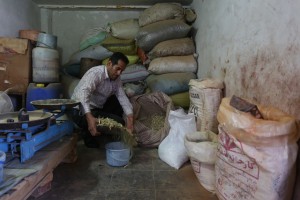
To see the dying process in Farahan carpet, refer to the link below.
To get more pictures from the dyeing process in Farahan Carpet, go to the link below.


