
how to weave a carpet in different regions
how to weave a handmade carpet?
There are different textures in the eastern countries according to the customs of different regions. In Iran, as we mentioned earlier, weaving carpets are classified into Persian and Turkish regions. In this post, we will briefly mention how the carpet weave in these two regions
Handmade carpet components
As we know, a handmade carpet consists of three main components: warp, weft, and yarn. These three components can be made of wool, silk, and cotton. With regard to the number of wate, the thickness of the warp and weft and yarn are changeable.
warp
warp is often made of cotton but in areas such as Qom and Tabriz, too, fine silk carpets are also used, although working with it requires high skill. In nomadic areas, they also use woolen yarns for warps.
weft
The weft is often made of cotton, but in nomadic areas, the woolen weft is also used for Gaebet’s texture. The texture region uses one to several wefts after each wate.
yarn
the yarn is, in fact, the main component of a handmade carpet created by a knot, in fact, without our knots, we have a simple woven knit fabric, but with knots, which handmade carpet takes identity and roles.
The knots are mostly made of wool. However, for carpets with high altitudes and in areas such as Qom and Tabriz, silk is used for tissue fabrication of Ribbon carpets which requires special skill.
Types of knots and how they are textured
In Iran, two types of knots are used: Persian knot or asymmetric knot, which sweeps through the edge of a warp and sweeps around the warp. In Iran, the Persian region includes the central, southeastern and eastern parts of Iran.
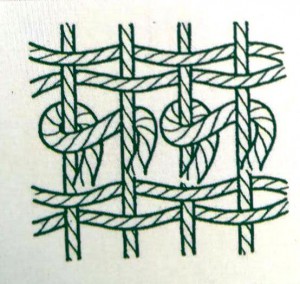
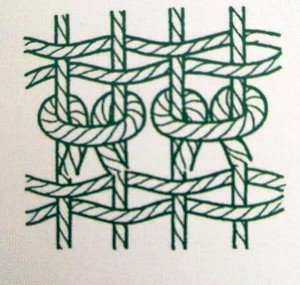
The other knot is called the Turkish knot or symmetric, which, as it is known from the name, the yarn is symmetrically rounded around both warps.
knitting process
Before the beginning of the original texture of the carpet, in order to strengthen the first weaving work of the weaving chain and, then begins to make the original texture. For tissue knitting, a tool called knitting knife (Persian ) and knife hook (Turkish ) is used.
Before Reading patterns begin, the weaver first performs several simple weaving wate, usually in the background color and visible around the carpet.
Typically, the weaver, after each tissue wate, rejects a thick, then a thin layer of wefts, and performs a beating operation. To break down the work is used from Kirkit (Farsi-Baf) and Dafe or Daftin (Turkish Bough).
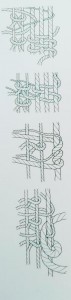
For strength and endurance, Selvadges is used in carpets on the sides of the carpet along the length of the carpet and the edge of the screws. Other names are screwing, screw driving. The edges of the Selvadges have different types and are woven in different areas in different shapes.
In general, the edges of the Selvadges are divided into two groups, separated and connected. The connected one is wound together with the carpet and continues to the end of the carpet. separated Selvadges added by a specialist after cutting the carpet and
The artist’s weaver, based on the plan and the design, weave the carpet and we see the spirit and love and feelings of her at the end so the weaver is well understood and because of this fact, a hand-made carpet gives us a sense of liveliness.
an artist weaver is weaving a carpet by love
Images of knots and Selvadge from the carpet book of Dr. Taher Sabahi


