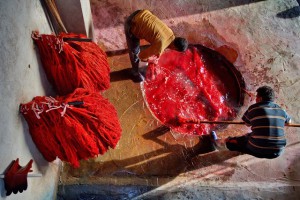
history of dying
history of dying
Dyeing begins with the human body before it starts from skin or fabric. The right to self-restraint was more than usual for men. This first form of art was used to attract women’s attention or to frighten enemies. In some tribes, painting is a monopoly of men. The human has always been looking for beauty, and at first, he tried to beauty in different colors, and then they came to tattoos because they were not mana.
In the knitting fan, the animal was also the master of human beings, and the animals came to the art of weaving and carpet weaving using spider and nest, the fish and birds bones they were able to make needles that threaded them through. In this regard, the human has known that colorful woven fabrics have a special look and it will come to them to dye the wool and cotton they need for their woven fabrics.
After a while, humans discovered that the colors extracted from the soil and minerals were not suitable for absorption because of their unwillingness, so trying to discover the colors of the plants and animals. The first discovered colors are the same as the main yellow and red colors, which were obtained from the root of the rhizosphere and red beetroot, blueberry and rosehip and yellow beetroot from Rafanan, Spurk, Berber leaves and Yellowwood.
HISTORY OF DYEING IN DIFFERENT COUNTRIES
China
China has the oldest artistic tradition. The mainland of the silk that wearing colored dresses has been commonplace among the Centenary civilizations. Evidence has shown that the Chinese have a full-fledged reddish red beetle, a blue color of Nile and a green color of the extract of several different herbs.
Sumer
In Sumer, dying has been considered as a homeworker, and he has been entrusted with slaves. And the way of dyeing works, as much as possible, preserved as a secretive breaststroke.
Iran
In pre-Islamic Iran, dying had old traditions, unlike other nations, the drones were highly respected in Iran, and until recently they identified from their face and colored clothes.
Evidence such as the wall-mounted image of Susa that depicts soldiers with brightly colored dresses and designs that have been typographed as Batik, suggests that Iranians have known this art for many years.
India
The origin of the Indian Nile plant and the cotton plant in India. Cotton was originally planted that grew up in India, and on the other hand, the first ones discovered the plant and also the usage of Nile were Hindus. They used the Nile to paint their fabrics.
It is evident from Indian cloth that Indians were interested in colorful fabrics and even painted their beard, and the dyestuffs had an especial fraternity. On the other hand, weather conditions were also favorable for the growth of various dye plants.
Egypt
The discovery of mummies in Egypt was found to have covered them in a colorful woolen coat, but it was not clear about the exact color of the wool. The Egyptians used cotton and linen more than their wool because they originated from plants and believed that the plants were clean, and they used sheep wool only in certain cases, such as the shroud of the dead.
Papyrus, discovered in 1828, is one of the oldest dyeing editions that remained completely healthy due to the dry air and lack of moisture. One of these papyrus has been talked about the hardness of the yellow color when working with purple oysters. Part of this papyrus is a reference book about dyeing wool and more purple ornamentals. These papyri are said the dyeing steps.
Another valuable asset is the discovery of the remains of a dyeing workshop in the Pyramids of Egypt, which consists of two separate rooms, a room for dyeing cabins with red and blue colors, and another room of the water that has large water ponds. And a room with a thick wall which separated from these rooms, which is likely for dyeing Customers, and the existence of the wall was to keep the work of the rumble was used. the roof of this place used to dry the fabrics and dyed yarns.
For more information on the dying process, refer to the following
Also, to view more pictures of dyeing steps in Farahan Carpet Co., please refer to the following
In the next post, the colors and their characteristics will be discussed